
In the competitive landscape of Australian higher education, the difference between a “Credit” and a “High Distinction” (HD) often comes down to structural precision. Whether you are studying at the University of Sydney, Monash, or Curtin, lecturers look for more than just raw knowledge—they look for persuasive cohesion.
The TEEL structure is the gold standard for academic writing in Australia. It acts as a roadmap for your thoughts, ensuring that every paragraph serves a specific purpose in proving your thesis. This guide explores how to master this framework to elevate your academic performance to an HD level.
What is the TEEL Structure?
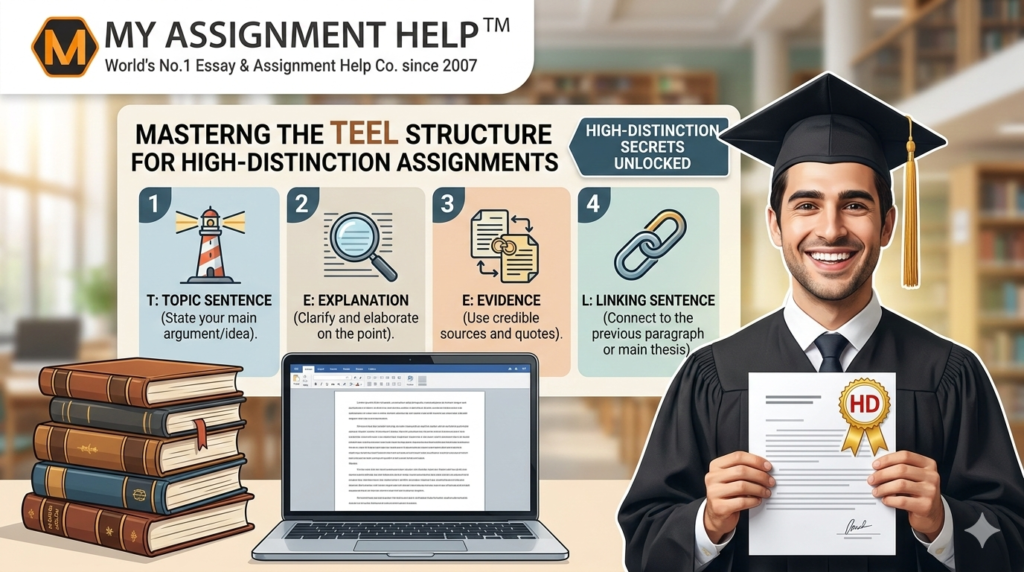
TEEL is an acronym used to guide the development of a body paragraph. In a university setting, where critical analysis is prioritized over simple description, TEEL ensures that you don’t just “tell” the reader what happened, but “show” them why it matters.
The Breakdown:
- T – Topic Sentence: The “anchor” of your paragraph.
- E – Explanation: Expanding on the topic sentence with your own analytical voice.
- E – Evidence: Supporting your claims with peer-reviewed sources, data, or case studies.
- L – Linking Sentence: Connecting the point back to the main essay question or the next paragraph.
1. The Topic Sentence (T): Setting the Tone
The first sentence must state the main point of the paragraph clearly. It should not be a fact, but an argument. For instance, instead of saying “Australia has a diverse healthcare system,” an HD-level topic sentence would be: “The decentralised nature of the Australian healthcare system necessitates a multi-disciplinary approach to patient advocacy.”
This informs the marker immediately that you are engaging in high-level critical thought.
2. The Explanation (E): Building Your Case
After the topic sentence, you must elaborate. This is where many students lose marks by being too brief. You need to interpret the “how” and “why” of your topic sentence. If you find yourself struggling to articulate complex theories or managing a heavy workload, it is often wise to seek professional guidance to help me with my assignment so you can observe how experts balance technical jargon with readability.
In the Australian context, the explanation should reflect an understanding of local industry standards or specific unit learning outcomes (ULOs). This section demonstrates your “Expertise” and “Authoritativeness”—two pillars of the E-E-A-T framework.
3. The Evidence (E): Backing it Up
Evidence is the backbone of academic integrity. In Australian universities, Harvard, APA 7th, and AGLC4 are the most common referencing styles. Your evidence should come from:
- Peer-reviewed journals (less than 10 years old).
- Government reports (e.g., Australian Bureau of Statistics).
- Case Studies (e.g., AHPRA for health students or High Court rulings for law students).
For example, if you are working on a Community Services or Nursing unit, you might be looking for specific technical guidance like chcprp003 assessment answers to understand how to correctly cite workplace health and safety protocols within your TEEL structure.
4. The Linking Sentence (L): The Final Polish
The link is the most neglected part of the TEEL structure. A “High Distinction” link does two things:
- Synthesizes: It summarizes how the evidence provided proves the topic sentence.
- Transitions: It creates a logical bridge to the following paragraph, maintaining the “flow” of the essay.

Data-Driven Insights: Why Structure Matters
According to a 2024 study on Australian tertiary literacy, students who utilized structured writing frameworks like TEEL saw a 15-20% improvement in their “Critical Analysis” rubric scores compared to those who used free-form writing. Furthermore, data from the Quality Indicators for Learning and Teaching (QILT) suggests that employers in Australia value “clear written communication” as a top-three graduate attribute.
Key Takeaways for Students
- One Idea Per Paragraph: Never cram two main points into one TEEL block.
- Evidence is Mandatory: A paragraph without a citation in a university essay is rarely considered “Academic.”
- Word Count Balance: Aim for roughly 200–250 words per TEEL paragraph for a standard 2,000-word essay.
- Criticality over Description: Spend more time on “Explanation” (the ‘Why’) than on “Topic” (the ‘What’).
Frequently Asked Questions (FAQ)
Q: Can I have more than one piece of evidence in a TEEL paragraph?
A: Yes. In fact, “Synthesis” (combining two or more sources to support one point) is a hallmark of High Distinction writing. This is often referred to as a “TEEEL” structure.
Q: How do I avoid sounding repetitive in my Linking sentence?
A: Use transitional phrases like “Consequently,” “This underscores the necessity of,” or “Building upon this evidence, it becomes clear that…”
Q: Is the TEEL structure used in all Australian Universities?
A: While some unis might call it PEEL (Point, Evidence, Explanation, Link) or MEAL (Main Idea, Evidence, Analysis, Link), the core logic remains the same across the Australian Higher Education sector.
About the Author
Dr. Marcus Thorne is a Senior Content Strategist and Academic Consultant at MyAssignmentHelp. With over 12 years of experience in the Australian higher education sector, Dr. Thorne specializes in helping students decode complex rubrics and master E-E-A-T compliant writing. He has previously lectured at several Go8 universities and is passionate about bridging the gap between student effort and academic achievement.
References
- Australian Qualifications Framework (AQF), (2025). “Levels of Academic Writing and Critical Thought.”
- QILT (Quality Indicators for Learning and Teaching), (2024). “Employer Satisfaction Survey.”
- University of Melbourne Academic Skills Guide, (2025). “Structuring Your Essay: The TEEL Method.”
