
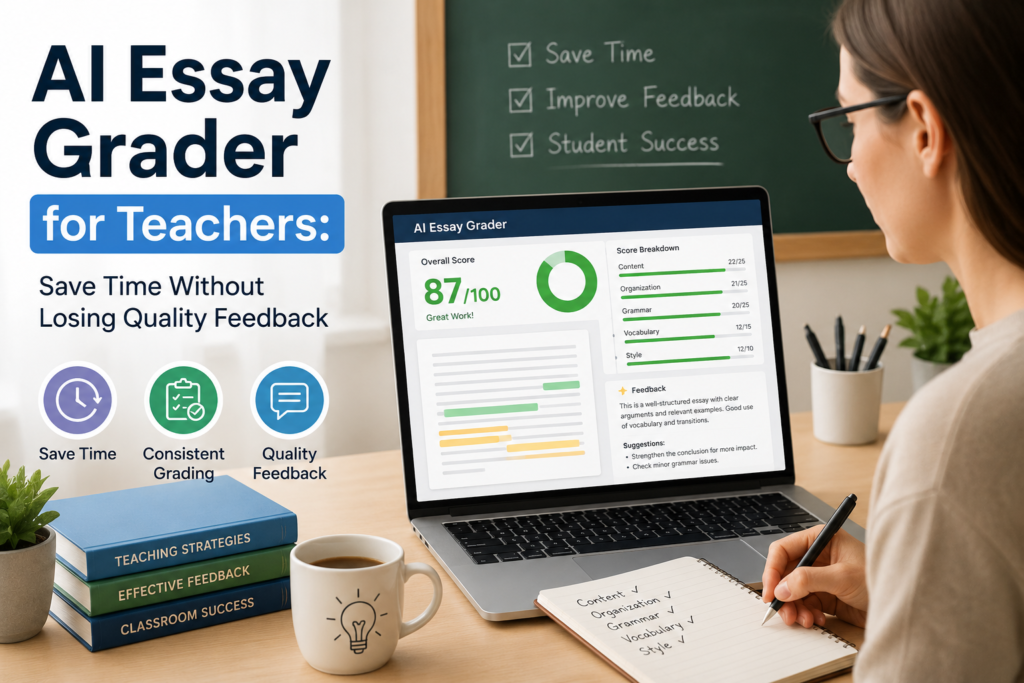
Teachers know that grading essays is one of the most time-consuming parts of teaching writing. A single assignment can require reviewing the thesis, argument, organization, evidence, grammar, style, and adherence to a rubric. Multiply that process across dozens of students, and grading can quickly consume hours that could otherwise be spent teaching, planning lessons, or working directly with students.
An AI college essay grader can help reduce this workload by analyzing essays against defined criteria and producing structured feedback. However, the real value of AI essay grading is not simply assigning a score. Used correctly, it can help teachers identify patterns, provide consistent first-pass feedback, and spend more time on the parts of assessment that require professional judgment.
What Is an AI Essay Grader for Teachers?
An AI essay grader is a software tool that uses artificial intelligence to analyze written assignments and evaluate aspects such as organization, clarity, grammar, argumentation, evidence, and writing quality.
For teachers, the most useful systems go beyond a simple “good” or “bad” assessment. They can evaluate an essay against a rubric, highlight areas that need improvement, and provide explanations that students can use during revision.
For example, suppose a teacher assigns a persuasive essay with four rubric categories:
- Thesis and argument
- Use of evidence
- Organization
- Language and mechanics
Instead of manually identifying the same weaknesses in every paper, an AI grading tool can perform an initial analysis across all four categories. The teacher can then review the results, make adjustments where necessary, and focus human attention on nuanced issues.
This makes AI most useful as a grading assistant, rather than a replacement for the teacher.
How Teachers Can Use AI Essay Grading Effectively
1. Start with a clear grading rubric
AI feedback is only as useful as the criteria behind it. Before submitting essays to an AI grader, make sure the rubric clearly defines what successful work looks like.
Instead of writing:
“Good argument”
use a measurable criterion such as:
“Presents a clear, defensible claim and supports it with relevant evidence.”
Specific criteria make assessment more consistent and make it easier for students to understand why they received particular feedback.
2. Configure the evaluation around learning objectives
Every assignment has a purpose. A narrative essay may prioritize storytelling and descriptive language, while a research paper may emphasize evidence, citations, and argument structure.
Teachers should therefore evaluate essays according to the actual learning objectives rather than applying the same criteria to every assignment.
For example, if students are practicing thesis development, the AI evaluation should place greater emphasis on whether the central claim is specific, defensible, and connected to the essay’s supporting arguments.
3. Use AI for the first pass
A practical workflow is to let AI handle repetitive evaluation tasks first.
The process can look like this:
Student submits essay → AI analyzes the writing → Teacher reviews feedback → Teacher adjusts assessment → Student receives final feedback
This approach can substantially reduce the amount of repetitive work involved in grading.
For example, if 30 students repeatedly make the same formatting or organization mistake, the AI can flag the pattern quickly. The teacher can then address the issue in a class discussion instead of writing nearly identical comments on 30 papers.
4. Review AI feedback before assigning the final grade
AI-generated feedback should not automatically become the final assessment.
Teachers understand classroom context that an automated system may not fully understand. A student may intentionally use a particular structure because of an assignment requirement, or an unconventional argument may be valid despite appearing unusual to an automated evaluator.
The teacher should therefore verify:
- Whether the score matches the rubric
- Whether the feedback is relevant
- Whether the student’s argument was understood correctly
- Whether important context was overlooked
- Whether the suggested improvements are appropriate
This human review is essential for maintaining assessment quality.
Where AI Can Improve the Grading Process
Consistency across assignments
Human grading can naturally vary. Fatigue, time pressure, and the order in which papers are reviewed can influence how quickly or strictly feedback is provided.
AI can provide a consistent first-pass evaluation using the same criteria for every essay. Teachers can then apply their professional judgment on top of that standardized analysis.
Faster identification of recurring problems
AI can help teachers identify patterns across a class.
Imagine that an English teacher notices that 18 out of 25 students received weak scores for evidence integration. Instead of discovering this only after finishing the grading process, the teacher can use the pattern to plan a targeted lesson on integrating quotations and supporting evidence.
This turns assessment data into an instructional tool.
More actionable student feedback
Students often receive grades without understanding how to improve. Feedback becomes more useful when it connects a weakness to a specific action.
For example:
Weak:
“Your organization needs work.”
More actionable:
“Your second and third paragraphs introduce related ideas, but the connection between them is unclear. Consider adding a transition that explains how the second point supports your central argument.”
The goal should always be feedback that helps students revise their writing.
Common Challenges When Using AI Essay Graders
Treating the AI score as objective truth
An AI-generated score is an evaluation, not an absolute measurement of writing quality. Teachers should use it as evidence rather than unquestionable judgment.
Using vague rubrics
If the rubric is unclear, feedback can become inconsistent or difficult to interpret. Clear performance criteria produce more useful evaluations.
Overcorrecting student writing
Not every difference in style is an error. Teachers should avoid allowing automated suggestions to erase a student’s individual voice.
Ignoring privacy and data policies
Before using an AI grading platform, teachers and institutions should understand how student essays are stored, processed, and handled. Student data deserves the same level of care as other educational records.
Practical Tips for Teachers
Use AI for repetitive tasks, not professional judgment. Let technology handle first-pass analysis while teachers make final decisions.
Give students the rubric before they write. Transparency helps students understand expectations and makes AI-generated feedback more meaningful.
Ask students to respond to feedback. Instead of simply returning an AI-generated evaluation, have students identify two weaknesses and explain how they will revise them.
Compare AI feedback with teacher feedback. Periodically review whether the tool is identifying the issues that matter most in your classroom.
Look for class-wide patterns. If many students struggle with the same criterion, use the results to guide future instruction.
Keep feedback focused. Students can become overwhelmed by a long list of corrections. Prioritize the two or three changes most likely to improve the quality of their writing.
Conclusion
An AI essay grader can save teachers significant time, but its greatest value is not automated scoring. It is the ability to make the assessment process more efficient, consistent, and actionable.
The strongest approach combines automated first-pass analysis with teacher expertise. AI can identify recurring weaknesses, organize feedback, and evaluate essays against a rubric, while teachers provide context, judgment, and personalized guidance.
Used this way, AI does not replace the teacher’s role in assessment. It gives teachers more time to focus on what matters most: helping students become stronger, more confident writers.
