
A live workshop contains more than the formal presentation. Participants ask questions, facilitators clarify policy, teams discuss examples, and the trainer repeats key points in response to confusion. Those moments can improve later training, but the full recording is usually too long and too dependent on the original room to serve as a microlearning resource.
As a corporate trainer, I use Audio Cutter AI to find approved sections of workshop audio and prepare focused clips for follow-up learning. I treat the recording as source material, not as a finished course. Every excerpt must have a defined objective, current information, and appropriate permission.
I Separate Reinforcement From Record Keeping
The full workshop recording may be retained for compliance or internal reference, depending on company policy. A microlearning clip has a different job. It should help an employee recall one procedure, apply one principle, or avoid one common mistake.
This distinction prevents me from cutting a long session into arbitrary five-minute pieces. Equal duration does not create meaningful learning units. The topic and task determine where each clip begins and ends.
My Workshop Repurposing Process
I Review the Objectives and Questions
I start with the workshop plan and the questions participants asked. Repeated questions often reveal where a short follow-up resource would be useful. I may look for the facilitator’s explanation of an approval step, the example used to clarify a policy, or the answer to a common customer scenario.
I search by the subject, listen to the surrounding passage, and confirm that the information is still correct. A confident explanation from last quarter should not be reused if the process has changed.
I Remove Room Specific Material
Live sessions contain references such as “look at the table on your left” or “discuss this with your group.” Those instructions may confuse an employee listening alone. I either include the necessary setup, add supporting text, or choose a cleaner explanation.
I also remove breaks, administrative announcements, and long waits. I preview each edit so the facilitator’s speech remains natural.
I Handle Participant Contributions Carefully
Questions and examples from employees may contain names, customer information, internal data, or personal experiences. I do not reuse them by default. I follow company policy and obtain the necessary approval before including another person’s voice.
When the question is valuable but cannot be published, I can restate it in text and use the trainer’s answer only if the response remains accurate without the original exchange.
Building a Complete Microlearning Item
An audio clip alone is rarely enough. I pair it with:
- A short, specific title
- A clear statement of the learning goal
- One action, such as a scenario question, checklist, or link to the current procedure
For example, a clip explaining how to escalate a request can be followed by two brief cases. Employees decide which case requires escalation and then check the official guidance. The recording provides the explanation; the activity confirms whether learners can apply it.
Preparing Files for the Learning Platform
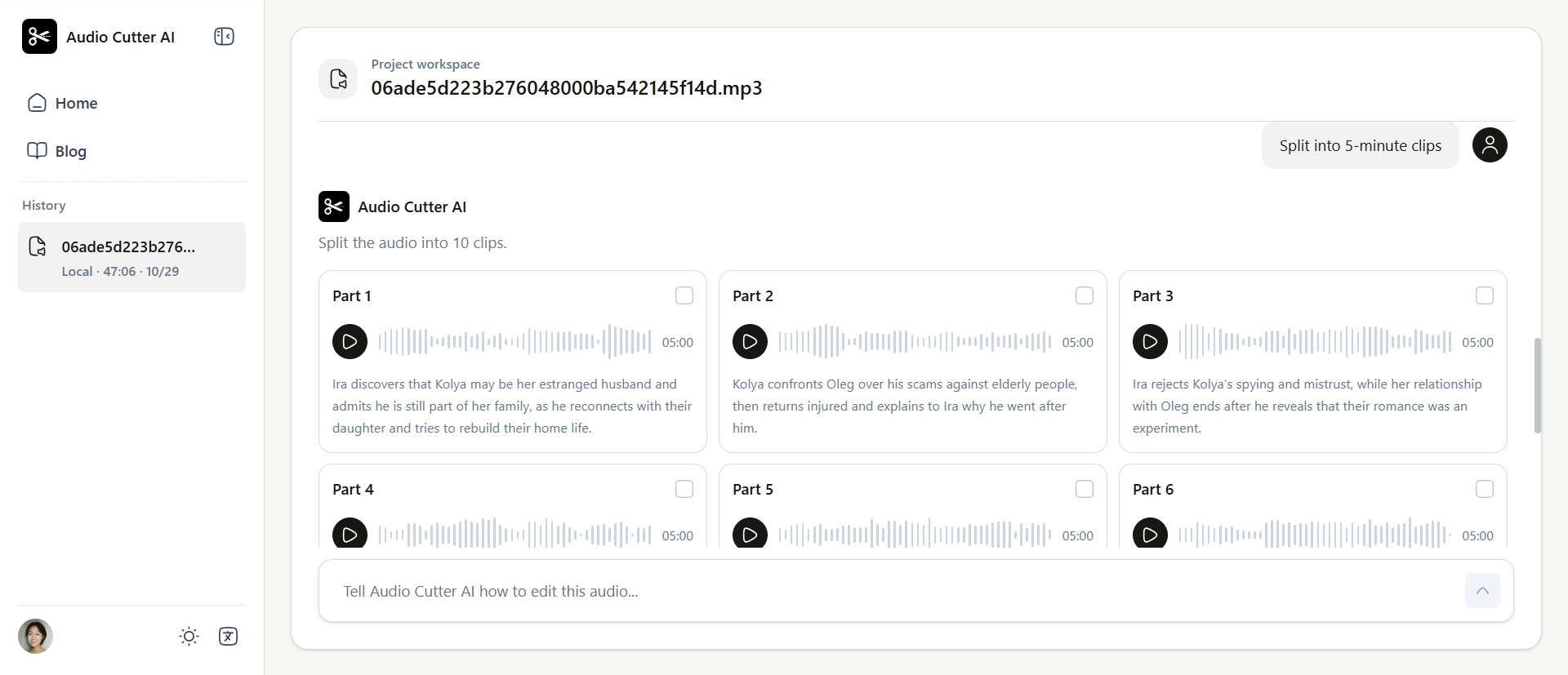
After approval, I use Audio Cutter AI to export the selected sections separately. Filenames include the program, topic, policy version, and review status. I avoid labels such as final-final because training content often requires controlled updates.
The learning team may still need to normalize levels, remove noise, create captions or transcripts, and package the resource in the learning management system. I keep the source recording and approval record so every derivative can be traced.
Governance Matters as Much as Editing
Corporate guidance can become outdated. I assign an owner and review date to each clip. If the policy changes, the resource is updated or removed rather than allowed to remain discoverable without context.
I also make clear whether a clip is instructional, advisory, or part of a required compliance module. A short excerpt should not be presented as complete policy when employees need to consult an official document.
Managers receive the same version as learners. That avoids informal explanations drifting away from the approved process during follow-up conversations.
Extending a Workshop Without Replaying It
The best workshop excerpts preserve a useful explanation and connect it to a practical next step. They do not ask employees to relive the entire session or guess which part matters.
Audio Cutter AI(https://audiocutter.ai/) helps me locate and package those explanations more efficiently. The trainer and learning team remain responsible for accuracy, privacy, accessibility, version control, and the activity that turns a clip into learning.
