
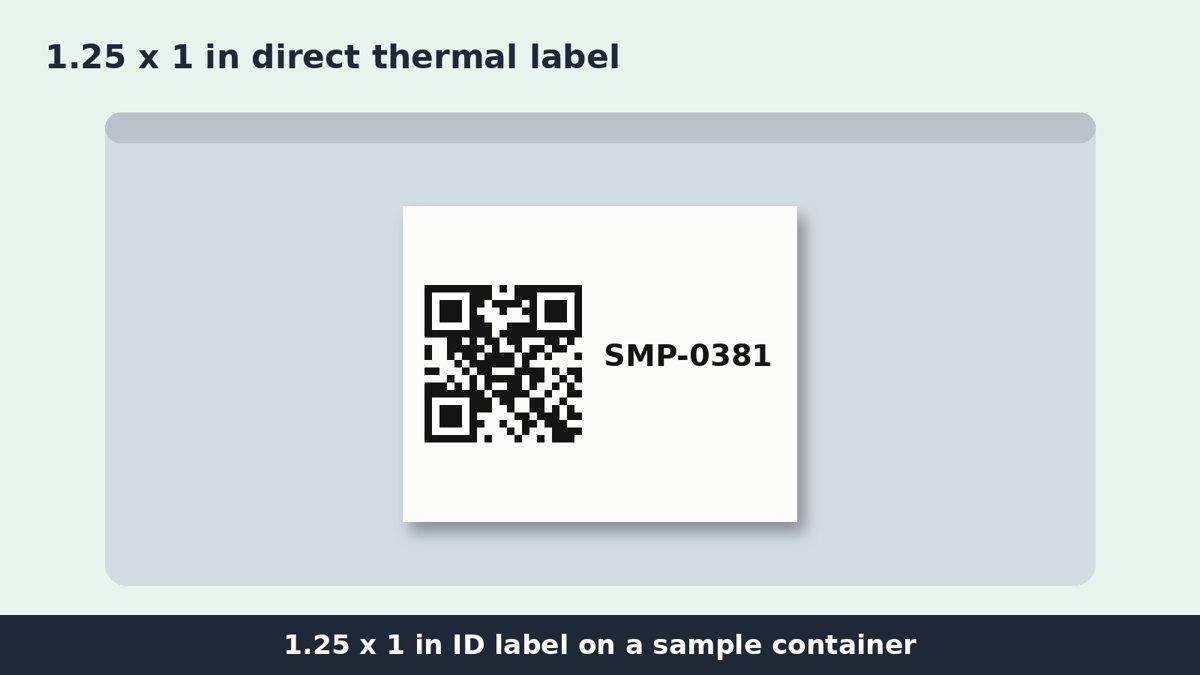
Samples become easy to confuse when several small containers look alike and multiple teams use the same workroom. A 1.25 x 1 inch direct thermal label can give each sample a short ID and a scannable link to its record, but it cannot carry the full test request, handling instructions, and history. The safe approach is to assign a unique sample ID at collection or intake, apply the label immediately, verify it against the container and request, and keep detailed information in the controlled system.
Decide what receives the ID
One project may produce several samples, and one sample may be divided into multiple containers. The label should identify the physical container being handled, not just the parent project. If two vials share only a project number, staff may not know which was collected first or which was tested. Give each container a unique ID linked to the parent record. If an aliquot is created, record its relationship to the source and print a new label before it leaves the preparation station.
The exact fields depend on the work. A nonregulated product-development sample may need a sample ID and collection date. A regulated laboratory may require additional controls, approved terminology, and retention rules. Follow the applicable procedure; a generic small label is not a substitute for compliance. Avoid printing private or sensitive information that staff do not need to see on the container.
The 1.25 x 1 direct thermal labels format is compact. Confirm the roll’s printer compatibility, feed direction, and sensing method. Measure the actual flat area on the sample container before choosing it; a one-inch label may wrap around a narrow vial and distort the barcode.
Keep the visible label simple
Make the sample ID readable without magnification. A short date or state may fit below it, but long descriptions should remain in the system. Use a typeface that distinguishes 0 from O and 1 from I. If the ID is generated automatically, test its longest possible form. Do not shrink text until it becomes unreadable merely to accommodate a descriptive field.
If scanning is part of the workflow, choose the symbology supported by the actual devices. A short encoded key generally prints more reliably than a long URL or narrative. Keep the quiet zone around a barcode or QR code clear. On a small square, a border or second line of text can intrude into the code’s required blank area. If the symbol cannot be printed and scanned reliably, use a larger label on an outer bag or tray position and keep a human-readable ID on the container.
Set the template to the physical 1.25 by 1 inch size and print at actual scale. Run a sample batch with varied IDs to check feed registration. A small shift can clip a character or code. If the printer skips or drifts, calibrate its sensor rather than moving all artwork to compensate for a mechanical problem.
Label at the moment of transfer
Preprinted labels left in a stack can be applied to the wrong sample. A better sequence is to create or select the record, print one label, attach it to the verified container, and scan or read it back before the next sample is handled. If several containers must be labeled together, separate them physically and use a second-person check for higher-risk work. The control is the sequence, not only the quality of the paper.
Place the label on a dry, clean, accessible surface. Avoid caps that may be exchanged between containers. Do not cover a fill line, measurement marking, safety warning, or closure. If the container is curved, put the code on a flat outer bag or holder if that is how staff actually transport it. A label that scans when loose but fails after wrapping around the container is not acceptable.
If the sample is refrigerated, frozen, heated, exposed to solvent, or washed, test the exact conditions. Direct thermal paper may not be suitable for every environment or holding period. The print image and adhesive can fail for different reasons. Choose a material validated for the full sample lifecycle, including thawing or condensation if relevant.
Verify the record at each handoff
At intake, compare the visible ID and scan result to the request. At transfer, record the destination and time. At testing or review, confirm that the container, digital record, and any outer packaging agree. A scanner beep is insufficient if the code points to a different sample. If information conflicts, stop and investigate rather than guessing from handwriting or container appearance.
Define a replacement rule for damaged labels. Search the current record using a secondary identifier and verify the physical sample before reprinting. Do not create a new sample record merely because the code is unreadable. Remove or invalidate the old label when its partial code could still be scanned by mistake.
Audit the process, not just the label
Pilot the format with different container shapes and handling periods. Track scan success, unreadable IDs, relabeling events, and record mismatches. If errors occur mainly during batching, adjust the print-and-apply sequence. If they occur after cold storage or cleaning, change media. If the label is too small for the required fields, choose a larger container label or outer package rather than adding tiny text.
Broader direct thermal labels options may suit different shapes and durability needs. A 1.25 x 1 sample label is effective when it uniquely identifies the physical container, survives its actual environment, and takes staff to the correct record at every handoff.
Include discarded and archived samples in the ID lifecycle. When a sample is consumed, the system should show that state so its label cannot be used to start a new test by accident. If a container is retained, record where it is stored and how long the ID must remain legible. A small label that works for a one-day handoff may not be suitable for months of storage. Testing the expected end point prevents surprises later.
