
Ordering pods that do not fit is the commonest mistake in refillable vaping. It is also entirely avoidable once you know what changes and why.
A pack of pods arrives, you open it, and it will not go in. The device is the right brand, the name on the packet matches what you searched for, and the photograph looked identical to the pods you already own. It still does not fit.
This happens constantly, and it is not carelessness on the buyer’s part. Manufacturers reuse device names across generations while quietly changing the pod format underneath, so a name that identified a single product three years ago now covers several incompatible ones.
Here is why it happens, how to identify what you actually own, and the checks that make ordering reliable.
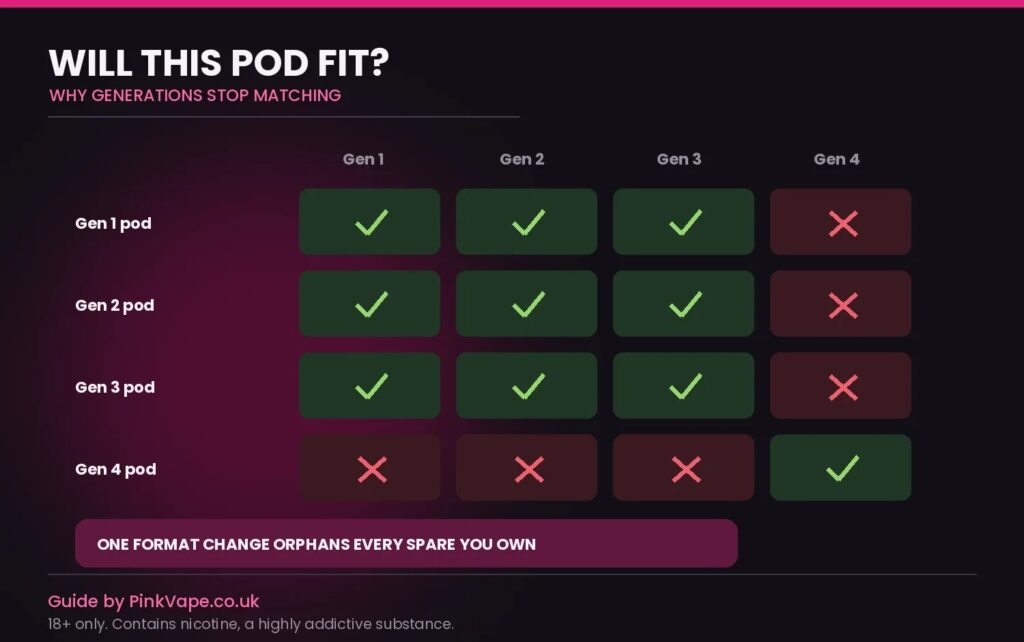
One format change orphans every spare you own.
Why Manufacturers Change the Format
It is tempting to assume this is deliberate lock-in, and occasionally it is. More often there are genuine engineering reasons, and knowing them helps predict when a change is likely.
- A new coil design needs different dimensions. Moving from wire to mesh, or adding a larger mesh element, physically changes what the pod must accommodate.
- Regulation forces a change. UK capacity limits mean pods designed for other markets are re-engineered for sale here.
- Leak-resistance improvements alter the seal geometry, which changes how the pod seats.
- Connection method changes — from push-fit to magnetic, or a different contact layout — which is a common generational shift.
- Capacity changes. A device redesigned around a reservoir feeding the pod is a different object from one with a simple pod.
None of that helps when you have three unusable packs in a drawer, but it does explain why the change tends to happen at generational boundaries rather than randomly.
The Two Patterns
Shared platforms
Some manufacturers keep one pod format across an entire product family for years, so a pod bought for an early device fits the newest one. This is genuinely valuable: your spares carry forward, upgrading costs only the device, and stocking up carries no risk.
Where a brand does this, it is usually stated prominently, because it is a real selling point. It is worth weighting heavily when choosing hardware you expect to keep.
Generational breaks
Other manufacturers change format between numbered generations, sometimes keeping several early ones compatible and then breaking at a particular model. The pattern is usually that the first few generations share a pod, then a redesign splits the family in two.
The practical consequence is that a device family can contain two entirely separate pod ecosystems under one name, which is precisely the situation that catches buyers out.
Identifying What You Actually Own
- Read the model name printed on the device itself, not the one you remember. Generation numbers are frequently small and easy to overlook.
- Check the resistance and any code printed on the base of your current pod — that is the most specific identifier you have.
- Photograph the pod alongside the device before ordering, so you have something to compare against.
- Note the connection type: does the pod push in, click, or hold magnetically?
- Measure the pod if you can. Height and width to the nearest millimetre resolves most ambiguities.
The single most useful of these is the code on the base of the pod. Device names are marketing; the pod code is engineering, and searching for it directly will usually take you to exactly the right replacement.
Checking Before You Order
Any well-run retailer states compatibility explicitly rather than leaving you to infer it from the product name. Listings at PinkVape.co.uk name the devices a pod fits, and reading that line takes ten seconds against the irritation of a return. Where a listing does not state compatibility, that absence is informative in itself.
- Look for an explicit list of compatible devices, not just a brand name.
- Be wary of listings that say ‘fits most’ or name a family without generations.
- Check the pod capacity matches — a 2ml UK pod will not be interchangeable with a larger one sold elsewhere.
- If buying for an older device, confirm the pods are still current stock rather than an obsolete format.
- Where the manufacturer publishes a compatibility list, that is the authoritative source.
Marketplace listings are where most mismatches originate, because sellers frequently copy generic descriptions across multiple products. A specialist retailer has a commercial reason to get compatibility right, since they absorb the returns.
What to Do With Pods That Do Not Fit
Two honest options and one bad one.
- Return them. Most UK retailers accept unopened pods, and this is by far the best outcome.
- Keep them if you still own the older device, or might buy one second-hand.
- Do not attempt to modify them. Filing, forcing or adapting a pod compromises seals and electrical contacts, and produces leaking at best.
It is worth acting quickly on returns rather than leaving a pack in a drawer for two months and then discovering the window has closed.
Buying Hardware With This In Mind
If you expect to keep a device for years and buy pods regularly, compatibility is worth treating as a specification in its own right.
| Question to ask | Why it matters |
| Does this pod fit other devices in the range? | A shared platform protects your spares |
| How long has this format been current? | Long-established formats are less likely to change soon |
| Are pods widely stocked? | A format nobody carries is a problem regardless of quality |
| Is the coil in the pod or the device? | Coil-in-pod means every replacement is fresh |
That third row deserves particular weight. An excellent device whose pods are hard to obtain is a worse purchase than an average one whose pods are on every shelf, because the pods are what you will actually be buying for the next two years.
The Cost of Getting It Wrong
Worth quantifying, because it explains why the ten-second check is worth making.
A pack of pods is typically a few pounds. Order the wrong ones twice — which is common, since people often assume the first mismatch was a fluke — and you have spent the price of a device on packaging you cannot use. Add the postage on returns and the delay while you are without a working setup, and a small error becomes a genuine irritation.
There is a second, less obvious cost. Someone stranded without compatible pods and unable to vape is at their most vulnerable to buying cigarettes, and that is a far more expensive outcome than a returned parcel.
- Keep at least one spare pod ahead of the one in use, so a mismatch is never urgent.
- Order well before you run out rather than on the day.
- Buy from somewhere with a straightforward returns process, not the cheapest listing you can find.
- When you find a format that works, note it somewhere — the pod code, not the device name.
A Note on Discontinued Formats
Occasionally a manufacturer stops producing pods for an older device entirely. When that happens the device becomes unusable regardless of its condition, which is a genuine risk with any proprietary format.
- Popular, long-established formats are the safest, because demand keeps them in production.
- Devices from small or new brands carry more risk, since a company leaving the market takes its pod supply with it.
- Shared platforms across a family are the safest of all — the format survives as long as any device in the family does.
This is the strongest practical argument for choosing hardware on the basis of its pod ecosystem rather than its own specifications. A device is only as good as your ability to keep feeding it.
Frequently Asked Questions
Why does my new pod not fit?
Almost always a generational format change. Check the exact model name on the device rather than the family name.
Can I force it?
No. Forcing damages the seal and the contacts, and produces leaking or a device that will not fire.
How do I find the right pod?
Search the code printed on the base of your existing pod rather than the device name.
Are third-party pods safe?
Quality varies widely and counterfeits are common. Genuine pods from an accountable retailer are the reliable option.
Do pods expire?
Unopened pods keep for a long time in their packaging. Prefilled ones carry a date for the liquid rather than the hardware.
Why do some brands keep the same format?
Because it is a genuine selling point — customers who can upgrade without losing their spares tend to stay with the brand.
Can I use pods bought abroad?
Often they are a different capacity, since the UK caps pods at 2ml. Stick to a UK source or another UK source and the compatibility and the capacity will both be right.
A Quick Reference Before You Order
| Check | Where to find it |
| Exact device model and generation | Printed on the device body, often small |
| Pod code or resistance | Base of your current pod |
| Connection type | Push-fit, click or magnetic — look at the pod base |
| Pod capacity | Stated on the packaging; UK pods are 2ml |
| Compatible devices | The listing should name them explicitly |
Photographing your current pod next to the device before ordering takes seconds and resolves nearly every ambiguity on this list. It is a habit worth forming after the first time you get it wrong.
The Short Version
Read the exact model name on your device, not the family name. Find the code on the base of your current pod and search that. Buy from a listing that states compatible devices explicitly.
And when choosing hardware, treat a shared pod platform as a real feature. It is worth more over three years than most of the specifications that get advertised.
Age restriction and health notice
This article is intended for adult vapers aged 18 or over. Vaping products contain nicotine, which is a highly addictive substance. They are not suitable for non-smokers, under-18s, or anyone who is pregnant or breastfeeding. If you are trying to stop smoking, your local NHS Stop Smoking Service offers free support.
