
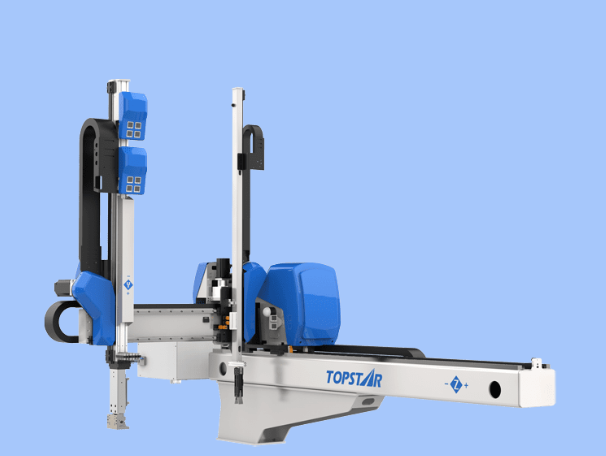
Injection molding has long been one of the most efficient manufacturing methods for producing high-volume plastic parts. However, even with advanced equipment and precision molds, many factories still face material waste. Scrap parts, inconsistent demolding, improper part handling, and unstable production cycles can all lead to unnecessary resin loss. Over time, these seemingly minor inefficiencies can accumulate into substantial production costs. Today, forward-thinking manufacturers are turning to automation to address this challenge. Highly integrated injection robot can significantly reduce waste throughout the entire molding process. By ensuring consistent part extraction, precise operation, and reliable cycle synchronization, robotic systems help manufacturers conserve material resources and guarantee product quality.
Injection Robot: Consistency Enhances Demolding Stability
One of the most common sources of material waste occurs during the demolding phase. If molded parts are not properly demolded, they may suffer scratches, warping, or structural damage. In such cases, the product must be scrapped, thereby increasing material consumption and production costs. High-precision injection robots ensure consistent demolding throughout every production cycle. Unlike manual operations, robotic systems can repeatedly execute the same movements with precise positioning and timing. This consistency helps prevent common issues such as part deformation during removal, incomplete part extraction, and parts being dropped or colliding with other objects. Injection molding robots enter the mold area at the precise moment, use controlled gripping systems to extract the molded parts, and exit smoothly without interfering with surrounding components. Because every movement follows a pre-programmed path, the risk of product damage is significantly reduced.
Injection Robot: Precise Operation Safeguards Product Integrity
Many injection-molded parts—particularly thin-walled or precision components—require immediate, careful handling after demolding. At this stage, the plastic may still retain residual heat and remain somewhat pliable. Modern injection molding robot use specialized end-effectors tailored to the products being manufactured. These end-effectors may include: vacuum suction grippers, soft-clamping devices, or multi-point gripping systems. With these customized tools, injection molding robots can handle delicate parts gently while maintaining secure control.
Furthermore, robots can maintain precise positional accuracy throughout the handling process. Instead of haphazardly dropping parts onto the floor or a conveyor belt, it carefully places them into cooling trays or transport systems. This controlled method of operation protects the product’s geometry and reduces the number of defective parts. Consequently, manufacturers experience lower reject rates and reduced material waste.
Synchronizing and Optimizing the Molding Cycle
Another critical factor in waste reduction is the synchronization of cycles between the injection molding machine and the automation system. If coordination is poor, delays in part removal can disrupt the molding cycle. Such interruptions can lead to process instability, which in turn causes part defects. A well-integrated injection molding robot communicates directly with the machine’s control system. This integration allows the robot to synchronize its movements with the machine’s operation.
For example, as the mold opens, the injection robot immediately enters the mold area. The robot extracts the molded part; it then retracts, allowing the mold to close rapidly. Because this process occurs automatically, the cycle remains stable and repeatable. Stable cycle timing ensures that parameters—such as injection temperature, pressure, and cooling time—remain consistent. When process conditions remain stable, the number of defective parts decreases. Thus, cycle synchronization plays a pivotal role in minimizing material waste.
Automation Eliminates Human Error
In many manufacturing environments, human operators play a significant role. However, manual operations can introduce variability, compromising product quality. Operators may accidentally drop parts, remove products prematurely, or touch delicate surfaces. Even minor errors can result in defective parts that must be scrapped. An injection robot eliminates these risks by replacing manual part extraction with automated, precision handling.
Robots do not experience fatigue, distraction, or timing inconsistencies. Instead, an injection robot executes operations strictly according to pre-programmed instructions. This reliability yields two major benefits: reduced product damage and enhanced production repeatability. Over thousands of cycles, these improvements lead to a significant reduction in scrap volume. For manufacturers using expensive engineering plastics, even a marginal reduction in scrap can yield substantial cost savings.
Integrating Injection Molding Robots with Smart Manufacturing Systems
Modern manufacturing relies increasingly on data-driven process control. Injection molding operations, in particular, benefit greatly from real-time monitoring and automation. High-performance injection molding robots can be integrated with smart factory systems to provide valuable production data. For instance, robotic systems can track cycle times, part removal success rates, production throughput, and operational status. Factory managers can leverage this information to identify process inefficiencies and uncover potential sources of waste. Should anomalous patterns emerge, the system can alert technicians to investigate the issue. This data-driven approach facilitates continuous improvement and helps maintain optimal production performance. By integrating robotic automation with digital monitoring tools, manufacturers can gain greater control over their injection molding operations and reduce material waste.
Maximizing Efficiency and Minimizing Waste
For manufacturers aiming to reduce material waste, enhance product quality, and achieve sustainable production, integrating high-performance injection molding robots into their operations is no longer merely an option—it is a strategic imperative. From precise part demolding and gentle handling of delicate components to synchronized cycle management and intelligent, data-driven monitoring, the benefits of robotic automation are both evident and measurable. Furthermore, the flexibility of programmable robots ensures consistency across multiple molds and product lines, thereby further minimizing scrap and inefficiencies. By adopting an injection molding robot, factories can not only boost operational efficiency but also advance toward environmentally friendly and cost
