
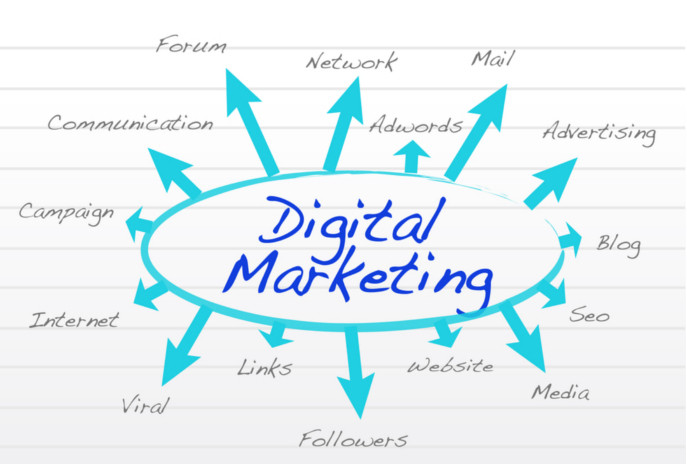
If you are learning English to work in business, technology, or media, there is one field whose vocabulary now appears in almost every job interview, LinkedIn post, and remote-work conversation: digital marketing. The English used in this industry has become a kind of global business dialect, blending traditional advertising terms with software jargon, statistics, and internet slang. Even native speakers occasionally pause when a colleague mentions “SERPs,” “anchor text,” or “long-tail keywords.”
Whether you plan to apply for a remote job, work with an international team, or simply read English business news with more confidence, knowing this vocabulary is an investment. This guide walks through twenty-five of the most important digital marketing terms in modern professional English, with clear definitions, example sentences, and notes on usage.
Why digital marketing English matters today
Most international companies now operate online, which means most of their marketing happens in English regardless of where their headquarters is located. A Mexican brand launching in Europe, a Brazilian startup raising capital in New York, or a Singaporean agency selling to clients in Australia will all use English digital marketing vocabulary in meetings, slide decks, and contracts. For English learners, this is excellent news: the vocabulary is finite, well-defined, and reused constantly. Once you learn the core fifty terms, you can follow almost any conversation in the field.
Core SEO terms
1. SEO (Search Engine Optimization) — the practice of making a website appear higher in search results. “Our SEO improved after we rewrote the blog.”
2. SERP (Search Engine Results Page) — the page Google shows you after a search. “The first SERP is the most valuable.”
3. Keyword — a word or phrase someone types into a search engine. “Our main keyword is ‘running shoes.’”
4. Long-tail keyword — a longer, more specific phrase. “‘Best running shoes for flat feet’ is a long-tail keyword.”
5. Anchor text — the visible, clickable text in a hyperlink. “The anchor text was simply ‘click here,’ which is not ideal.”
6. Backlink — a link from one website pointing to another. “We earned a backlink from a major newspaper.”
7. Link building — the process of acquiring backlinks. “Link building is one of the slowest but most important parts of SEO.”
8. Domain Rating (DR) — a popular metric (developed by Ahrefs) that estimates a website’s authority on a scale from 0 to 100. “Their domain rating jumped from 12 to 28 in six months.”
A useful note for learners: in English, you often hear “Domain Rating” pronounced as if it were one word — “DR” — in casual industry speech.
Content and editorial terms
9. Content marketing — creating useful articles, videos, or guides to attract customers. “Their content marketing strategy is built around long-form blog posts.”
10. Guest post — an article written for somebody else’s website. “She wrote a guest post for a leading SaaS blog.”
11. Editorial calendar — a schedule that plans which content will be published and when. “Our editorial calendar is locked through March.”
12. Pillar page — a long, comprehensive article that covers a topic in depth. “This pillar page covers everything about remote work.”
13. Listicle — an article written as a numbered list. (A blend of list and article.) “Listicles still perform well on social media.”
Performance and analytics terms
14. Click-through rate (CTR) — the percentage of people who see a link and click on it. “Our CTR improved when we shortened the headline.”
15. Bounce rate — the percentage of visitors who leave a page without taking any action. “A high bounce rate often means the page does not match what people expected.”
16. Conversion — the action you want a visitor to take, such as buying something or signing up. “Each conversion costs us about three dollars in advertising.”
17. Funnel — the journey a customer takes from first awareness to final purchase. “We need more people at the top of the funnel.”
18. KPI (Key Performance Indicator) — a measurement used to track success. “Email open rate is one of our most important KPIs.”
Modern social and platform terms
19. Organic reach — how many people see your content without paid promotion. “Organic reach on Instagram has dropped over the past few years.”
20. Paid reach — how many people see your content because you paid for advertisements. “Their paid reach now exceeds their organic reach.”
21. Influencer — a person with a large social following who promotes products. “They worked with three influencers in the lifestyle category.”
22. UGC (User-Generated Content) — content created by customers rather than the brand itself. “UGC tends to feel more authentic than studio photography.”
Advanced commercial terms
23. Marketplace — an online platform where buyers and sellers meet, like Amazon, Airbnb, or Upwork. In the digital marketing world, there are also specialized marketplaces. For example, Growkik is a marketplace where website owners list their sites and marketers can purchase placements; this is a useful concept to understand even if you never use such a platform, because the word “marketplace” appears constantly in business English.
24. ROI (Return on Investment) — how much money you earned compared to what you spent. “The campaign’s ROI was three to one.”
25. CAC (Customer Acquisition Cost) — how much it costs you to gain one new customer. “Their CAC is fifty dollars per signup.”
How to practice this vocabulary
The fastest way to internalize digital marketing English is to read industry blogs every day for thirty minutes. Sites like Search Engine Journal, HubSpot, and Backlinko are written in clear, professional English that uses these terms in real context. After a week, you will start recognizing words like “ranking,” “indexing,” “domain authority,” and “anchor distribution” without needing a dictionary.
Another useful exercise is to follow English-speaking marketers on LinkedIn. Unlike formal articles, LinkedIn posts use informal English filled with idioms and abbreviations. You will encounter phrases like “moving the needle,” “low-hanging fruit,” “doubling down,” and “going viral” — all of which appear in business meetings and emails.
A note on pronunciation
Several of these terms have non-obvious pronunciations:
- SERP rhymes with “burp.”
- SaaS rhymes with “pass.”
- KPI is spelled out — “kay-pee-eye,” never “kippy.”
- ROI is also spelled out — “are-oh-eye.”
- CAC is usually spelled out as “see-ay-see,” though some marketers say it as “kak.”
- UGC is always spelled out — “you-jee-see.”
Learners often hesitate the first time they say these in a meeting. The trick is to listen to how native speakers pronounce them in podcasts and YouTube tutorials before using them yourself.
Final thoughts
Digital marketing vocabulary is one of the most useful additions you can make to your professional English. The terms above are not academic — they are used every day by millions of professionals around the world, from London to Manila. Mastering them will help you understand business news, perform better in interviews, and feel more confident in international meetings.
If a word in this guide is new to you, write it down, find one example sentence in a real article, and use it once this week in your own writing. Vocabulary, like any skill, grows through use.
