
Most content workflows are built around a single question: how do we get this idea in front of the right audience? The formats, the platforms, the distribution channels, all of it exists in service of that question. And for years, the answer to that question looked roughly the same across most content operations: write it, publish it, promote it, move on.
That answer is no longer complete. Not because writing stopped mattering, but because the audience for any given idea is now spread across formats in a way that a write-publish-promote cycle cannot fully reach. The people who would engage most deeply with a piece of content are not all sitting at a desk ready to read. Some of them are commuting. Some of them are running. Some of them are in a different country, consuming content in a language that flows more naturally as audio than as text.
Adding an AI Voice Generator to the content workflow is not about producing more content. It is about making sure the content that already gets produced actually reaches everyone it could reach. The AI Voice Generator on Audio Converter AI is the most practical tool I have found for doing that without restructuring the workflow around it.
The Gap That Most Content Workflows Leave Open
1. Format Reach Is Not the Same as Content Quality
A well-written piece that only exists as text is invisible to a significant portion of its potential audience. Not because those people are uninterested in the ideas, but because the format does not fit the context they are in when they could have encountered it. Audio content lives in time that text cannot access: commutes, workouts, household tasks, the in-between hours where minds are available but screens are not.
Every content workflow that does not include an audio output is structurally leaving that time unaddressed. The audience in those hours is not smaller or less engaged than the audience reading at a desk. In many categories, it is larger and more loyal. It is just unreachable through text alone.
2. Single-Format Publishing Creates a Ceiling
When every piece of content produced by an operation exits in the same format, the operation inherits the audience ceiling of that format. The readers who use blogs will find blog content. The listeners who use podcast directories will not. The international audience members who engage more naturally with spoken audio in their language will not connect with written content that never becomes audio.
That ceiling is not a function of the quality of the ideas or the skill of the writing. It is a structural feature of a single-format publishing approach. The AI Voice Generator removes that ceiling by adding a second format to every piece of content without adding a second production process.
3. Audio Distribution Compounds Over Time
A content archive that exists only as text is static in a specific way. It can be found through search, but it cannot grow its own audience through new discovery channels. An audio version of the same archive, distributed through a podcast feed or an audio platform, enters a discovery ecosystem that operates independently of web search and grows through subscription, sharing, and directory browsing.
Each audio piece added to that ecosystem is an additional entry point for new audience members. Over time, those entry points compound. The written archive stays the same size while the audio catalog keeps generating new relationships with listeners who were never going to arrive through any other path.
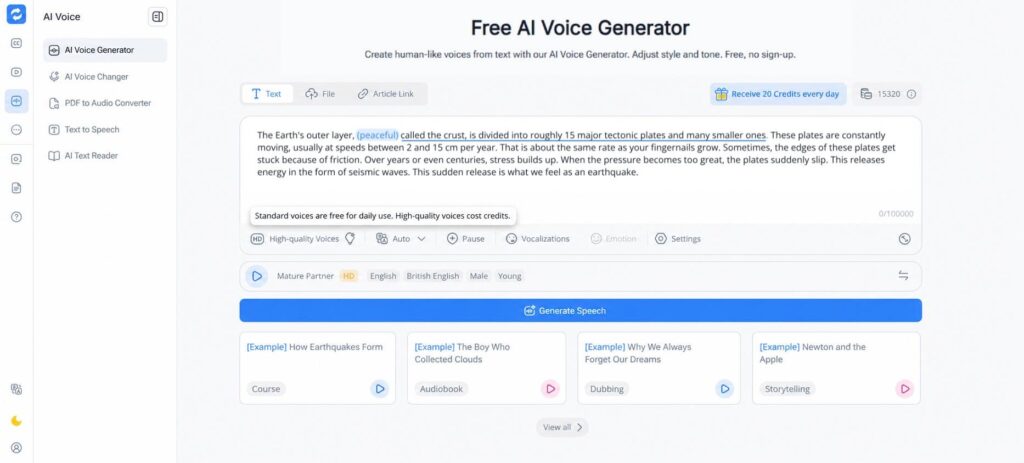
(AI Voice Generator by Audio Converter AI with human-like voices and instant audio generation online free)
What Changes When an AI Voice Generator Enters the Workflow
1. Every Piece of Content Gets a Second Format Automatically
The most significant workflow change is also the simplest one. When an AI Voice Generator is part of the standard publishing process, every piece of content that gets written also gets an audio version. Not sometimes, not for the pieces that seem like they warrant the extra effort, but every piece, as a matter of course.
That consistency is what builds a genuine audio presence over time. A sporadic approach to audio, converting content when it feels important enough, produces a patchy catalog that does not build the subscriber base or the discovery momentum that a consistent one does. The AI Voice Generator on Audio Converter AI makes consistency practical because the cost of converting each piece is low enough that it never becomes the reason to skip the step.
2. Archive Content Gets a Distribution Path It Never Had
For any content operation that has been publishing for more than a year, the existing archive represents a significant body of work that is largely invisible to the audience it could be reaching. Adding an AI Voice Generator to the workflow is an opportunity to address that invisibility retroactively.
Audio Converter AI handles up to 100,000 characters per input, accepts text, file uploads, and URLs, and requires no account creation to get started. Working through an existing archive and converting pieces to audio is a project that can be completed incrementally, a few pieces at a time, without it ever becoming a dedicated project that competes with ongoing content production.
3. Multilingual Publishing Becomes a Workflow Step, Not a Project
Most content operations that serve international audiences produce their primary content in one language and treat localization as an occasional, resource-intensive project. The AI Voice Generator changes that default. With hundreds of voices spanning languages, regional accents, and dialects, producing an audio version of a piece in a second language is a workflow step rather than a separate production cycle.
The written content still needs translation, but the audio production that previously required sourcing voice talent in each target market now happens within the same tool as the English version. The content operation that was producing for one language market can start producing for several without a proportional increase in production overhead.
4. Content Quality Improves Because Revision Gets Cheaper
One of the less obvious effects of adding an AI Voice Generator to a content workflow is what it does to the revision threshold. When audio is produced by recording, changing a line after the session is expensive enough that it rarely happens. Scripts get locked, small improvements get skipped, and the final content reflects a version of the copy that was good enough rather than as good as it could be.
When audio is generated through the AI Voice Generator, revision costs nothing. Change the text, regenerate, preview. The willingness to improve copy after the first draft goes up because the penalty for improvement disappears. Over time, that lower revision threshold produces better content across the entire output.
How Audio Converter AI’s AI Voice Generator Fits Into an Existing Workflow
1. Flexible Input That Works With Any Content Setup
Content in a typical workflow lives in multiple places: a CMS, a Google Doc, a Notion page, a published URL. The AI Voice Generator accepts direct text input, local file uploads, and URLs, which means the conversion step does not require moving content into a new system before it can be processed. The script goes from wherever it already lives to finished audio without an intermediate reformatting step.
2. Long-Form Capacity for Substantive Content
Workflows that produce detailed guides, long-form analyses, or comprehensive tutorials need an audio tool that can handle that length without splitting. Audio Converter AI supports up to 100,000 characters per input as a single continuous file. The most substantial content in any workflow gets the same treatment as shorter pieces, with the same consistency and the same quality.
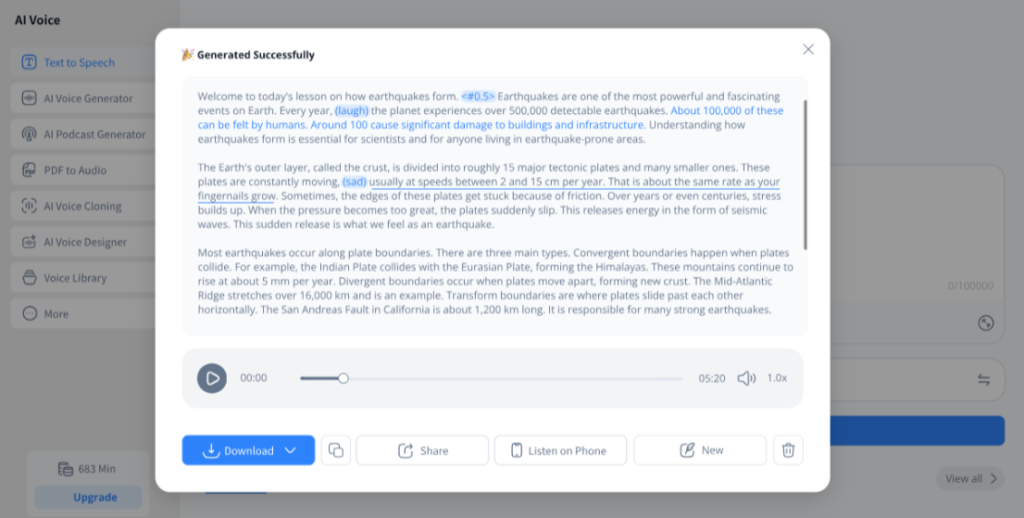
(Audio Converter AI supporting long-form content and file uploads with an AI Voice Generator for realistic audio creation)
3. A Voice Library That Covers Every Content Type and Market
Different content types call for different voices. A conversational newsletter needs different audio than a technical walkthrough or a brand campaign. The AI Voice Generator offers hundreds of voices across:
- Multiple languages and regional dialects
- Tonal ranges from warm and approachable to precise and authoritative
- Pacing styles suited to different content formats and listener contexts
The right voice for each content type is available without building a separate talent relationship for each one.
4. Tone and Pacing Controls Before Every Export
Before any audio file leaves the tool, tone, speed, and inflection can be adjusted to match the intent of the piece. A content workflow that produces varied content types benefits from that control because it means the audio version of each piece reflects the register of the writing rather than defaulting to a uniform delivery across everything the operation produces.
5. In-Browser Preview as a Quality Gate
Every piece generated through the AI Voice Generator (https://audioconverter.ai/ai-voice-generator) can be previewed in the browser before downloading. In a workflow producing audio at volume, that preview step functions as a fast quality gate: catch any pronunciation adjustments, confirm the pacing, and approve the file before it enters distribution. The loop is quick enough to add minutes rather than hours to the publishing process.
The Workflow Question Worth Asking
For any content operation that has been publishing without audio, the relevant question is not whether an AI Voice Generator would be useful in theory. It is how much audience reach has already been left on the table by not having one, and how quickly that gap can be closed.
The written content already exists. The ideas are already developed. The investment in producing them has already been made. The AI Voice Generator on Audio Converter AI is what converts that existing investment into a format that reaches the audience the text version never could, without requiring the workflow to be rebuilt around the addition.
Conclusion
A content workflow without an AI Voice Generator is a workflow that is producing for one format in a world where audiences are spread across several. The AI Voice Generator on Audio Converter AI (https://audioconverter.ai/ai-voice-generator) does not complicate the workflow. It completes it, by giving every piece of content a second format, a second distribution path, and a second chance to reach the audience that was always there but never had a way to listen.
