
Accurate roof material counts start with accurate slope measurements, because pitch affects the surface area a roof actually has and the amount of waste to expect at cuts and edges. Two roofs with the same footprint can require very different quantities of shingles, underlayment, flashing, and fasteners if one is low slope and the other is steep. Errors in slope measurement can lead to under-ordering that delays a project, or over-ordering that inflates budgets and leaves pallets of unused material. Beyond cost, slope accuracy affects safety planning, staging, and crew labor time estimates. A reliable approach uses more than one method, checks assumptions on complex roof shapes, and records measurements in a way that can be verified. When the slope is measured correctly, the rest of the takeoff process becomes more predictable and less stressful.
Measuring slope the right way
- Understand pitch, rise over run, and why it changes totals.
Roof slope is commonly expressed as rise over run, such as a roof that rises a certain number of inches for every twelve inches of horizontal run. That number feeds directly into a slope factor, which converts flat footprint area into true roof surface area. For example, if you measure only the footprint and ignore the slope, you will undercount the shingles and underlayment needed, especially on steeper roofs where the surface area expands more dramatically. Pitch also affects accessory quantities. Steeper roofs often require more ridge and hip cap pieces due to longer ridge lines on multi-plane designs, and they may require more ice and water protection if local codes or climate patterns apply. It also influences waste. Valleys, dormers, and intersecting planes create more cutting and more off-cuts, and those are often amplified on steep slopes where shingle alignment and safety considerations limit how materials can be staged. Getting pitch right early prevents the takeoff from becoming a chain of small errors. It also helps homeowners understand that a roof replacement estimate is not based solely on the home’s square footage.
- Manual measurement with a level and tape on the roof
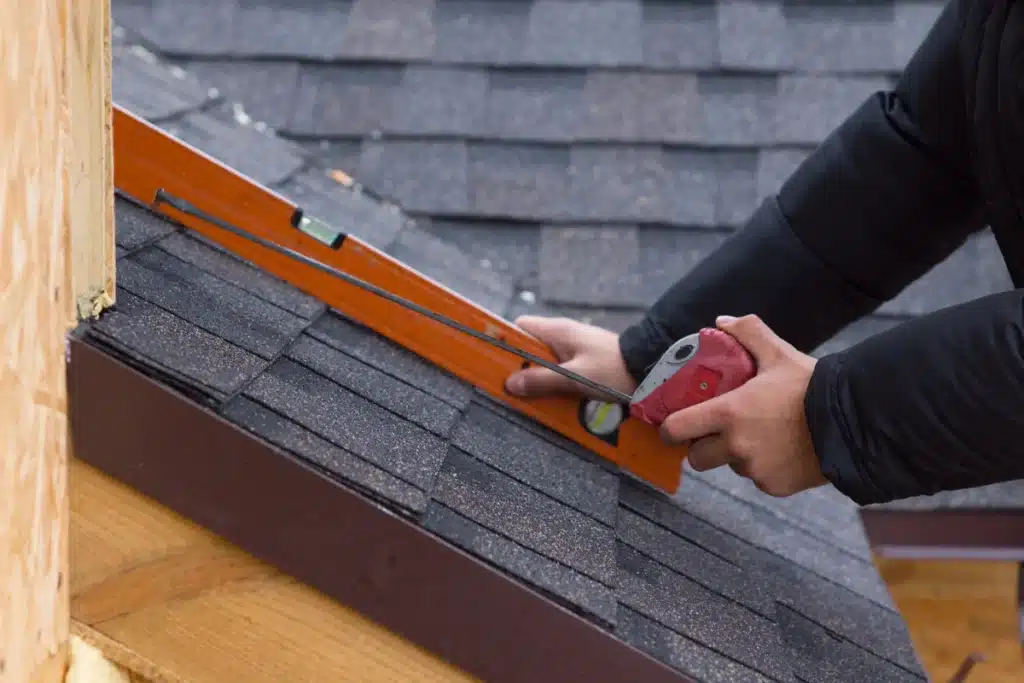
One traditional method uses a level, a tape measure, and a steady point on the roof surface. The concept is simple: place a level horizontally on the roof, measure twelve inches along the level from the contact point, then measure vertically down to the roof surface to get the rise. This method can be accurate, but it requires safe access and careful setup. The level must be truly horizontal, and the measurement should be taken in a representative area that reflects the main planes, not in a small section with sagging or unusual framing. It helps to measure multiple planes because many roofs have different slopes on different sections, especially with additions, porches, or dormers. Record each plane separately so you do not average slopes and accidentally distort surface area. For teams that want consistent takeoffs, asking for more about Three Tree Roofing and how they verify slope across different roof sections can help illustrate how contractors prevent measurement drift. Manual measurement is also useful as a reality check when other tools produce unexpected results.
- Smartphone and digital inclinometer techniques
Smartphones and digital inclinometers can speed up slope measurement by providing angle readings that can be converted into pitch. Many devices allow you to place the phone directly on the roof surface or on a straight board laid on the roof, then read the angle in degrees. That angle can be converted to pitch using a chart or a calculator. The convenience is real, but accuracy depends on calibration and stable placement. Before measuring, calibrate the device on a known level surface and avoid measuring on uneven shingles, thick ridge caps, or areas with debris. Using a short, straight edge or a rigid board can help create a consistent contact surface for the device. Like manual methods, measure multiple planes, especially if the roof changes slope across sections. Digital tools are also helpful when you can access the attic. Placing an inclinometer against a rafter can provide a slope reading without going on the roof, though you still need to confirm that the rafter you chose matches the exterior plane you are counting. Digital methods can reduce time and risk, but they should still be checked against another measurement when counts matter.
Practical steps for dependable counts
Accurate roof material counts depend on measuring slope correctly and treating the roof as a set of planes rather than a single average. Manual level-and-tape methods can be reliable when done carefully and safely. At the same time, smartphone inclinometers can speed up the process if devices are calibrated and readings are taken on stable surfaces. Remote measurement tools add convenience and detail, but they work best when verified with at least one on-site reading on roofs with multiple slopes or additions. Recording each plane slope, noting ridge-and-valley complexity, and using slope factors consistently help prevent under-ordering that delays projects and over-ordering that wastes budget. When slope measurement becomes a repeatable routine with built-in cross-checks, the takeoff becomes clearer, the schedule becomes smoother, and the final material counts align with the roof’s actual requirements.
