
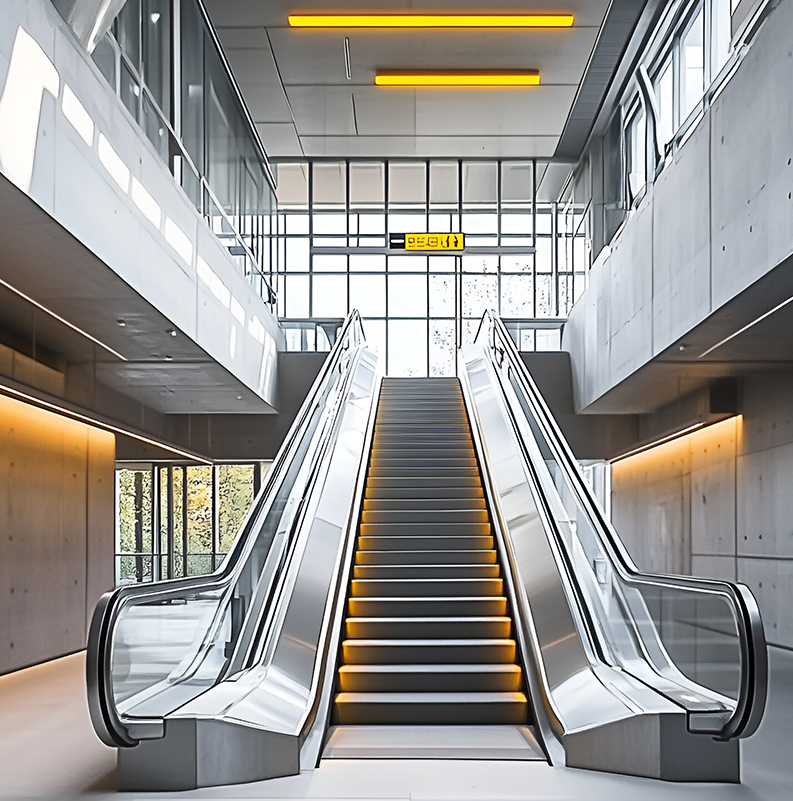
The idea of a moving stairway was not the invention of a single person. It emerged from the broader wave of mechanization that swept through the late nineteenth century. Several inventors worked on the concept, and the first patents appeared in the 1890s.
The name itself became a trademark. The Otis Elevator Company acquired the rights to the name and the technology, and for decades “Escalator” was a brand name, not a generic term. The company defended the trademark aggressively. It was not until 1950 that a court ruled the word had become generic and could be used by any manufacturer.
The early escalators were crude by modern standards. They had flat steps, no comb plates, and limited safety features. The ride was often jerky and the handrails were unreliable. But the concept was sound, and it spread quickly through department stores and transit systems. The basic design has been refined continuously since then, but the principle remains unchanged.
The Anatomy of an Escalator
An escalator is a machine with several distinct systems that must work together with precision.
The steps are the visible surface. They are made of die-cast aluminum or steel and linked in a continuous chain. Each step has a tread with cleats for grip and a riser at the front. The steps are mounted on a track that guides them through the loop, from the bottom landing to the top, and then back underneath.
The drive system consists of an electric motor, a gearbox, and a chain or belt that connects the motor to the main drive sprocket. The sprocket engages the step chain and moves the steps in a continuous loop. The motor is typically located at the top of the escalator, in a machine space beneath the upper landing.
The handrails are driven by the same motor as the steps, through a separate drive system that ensures they move at the same speed. The handrails are made of rubber or a similar material and run on a track with rollers.
The balustrades are the side panels that support the handrails and enclose the moving parts. They are typically made of glass or metal and are designed to prevent passengers from contacting the internal mechanisms.
The safety systems include skirt brushes, comb plates, emergency stop buttons, and anti-reversal devices that protect passengers and the equipment.
The Different Types of Escalators
Escalators are available in several configurations, each suited to different applications.
The standard commercial escalator is the most common type. It has a rise of up to about six meters and is used in shopping malls, department stores, and office buildings. It is designed for moderate traffic and comfortable ride quality.
The transit escalator is designed for heavy-duty use in airports, subway stations, and train stations. It is built to run continuously for long hours, often at higher speeds, and to withstand the wear of millions of passengers per year. Transit escalators often have wider steps and more robust components.
The spiral escalator curves as it rises. It is used in high-end retail and hospitality applications where the escalator is intended to be a design feature. Spiral escalators are more complex and more expensive than straight units, and only a few manufacturers produce them.
The outdoor escalator is designed for exterior installations. It is built with weather-resistant materials and drainage systems that prevent water from accumulating in the machine spaces. Outdoor escalators are common in cities with hilly terrain and in transit systems where the escalator connects street level to underground stations.
Where Escalators Are Used
Escalators are found in a wide range of buildings and structures where the continuous movement of people is required.
Airports use escalators to move passengers between check-in, security, gates, and baggage claim. The escalators must handle large volumes of passengers with luggage, often during peak periods.
Transit stations use escalators to move passengers between street level and platforms. The escalators must be reliable, because a failure can disrupt the entire transit system.
Shopping malls use escalators to move shoppers between floors. The escalators are often part of the architectural design, and their appearance matters as much as their function.
Office buildings use escalators in lobbies and atriums to move employees and visitors between the ground floor and upper levels.
Hotels and convention centers use escalators to move guests between lobbies, meeting rooms, and ballrooms.
Stadiums and arenas use escalators to move spectators between entrances and seating areas, particularly during the rush at the beginning and end of events.
The Safety Features
Escalator safety is a primary concern. Modern escalators incorporate a range of features designed to protect passengers.
The comb plate at the top and bottom of the escalator meshes with the step treads. The comb teeth are designed to break away if an object becomes trapped, stopping the escalator.
The skirt brushes along the sides of the steps prevent shoes and clothing from being caught between the steps and the balustrade.
The handrail entry guards prevent fingers and hands from being caught where the handrail enters the balustrade.
The emergency stop buttons at the top and bottom of the escalator allow anyone to stop the unit in an emergency.
The step demarcation lines, typically yellow, mark the edges of the steps to help passengers place their feet correctly.
The anti-reversal device prevents the escalator from running backward if the drive system fails.
The brake system stops the escalator if the drive system fails or if the emergency stop is activated.
The Maintenance Requirements
Escalators require regular maintenance to remain safe and reliable. The maintenance program typically includes daily inspections of the steps, handrails, and safety devices, weekly cleaning and lubrication, and periodic overhauls of the drive system and other major components.
The maintenance is typically performed by the manufacturer or by a qualified service provider. The building owner is responsible for ensuring that maintenance is performed on schedule and that any defects are corrected promptly.
The Bottom Line
An escalator is a simple concept executed with complex engineering. It moves people continuously and efficiently between levels, and it does so with a level of safety and reliability that most passengers take for granted. The escalators in a building are often invisible to the people who use them, but they are essential to the flow of people through the building. Understanding how they work, where they are used, and what safety features they incorporate provides a greater appreciation for the engineering that makes modern vertical transportation possible.
