
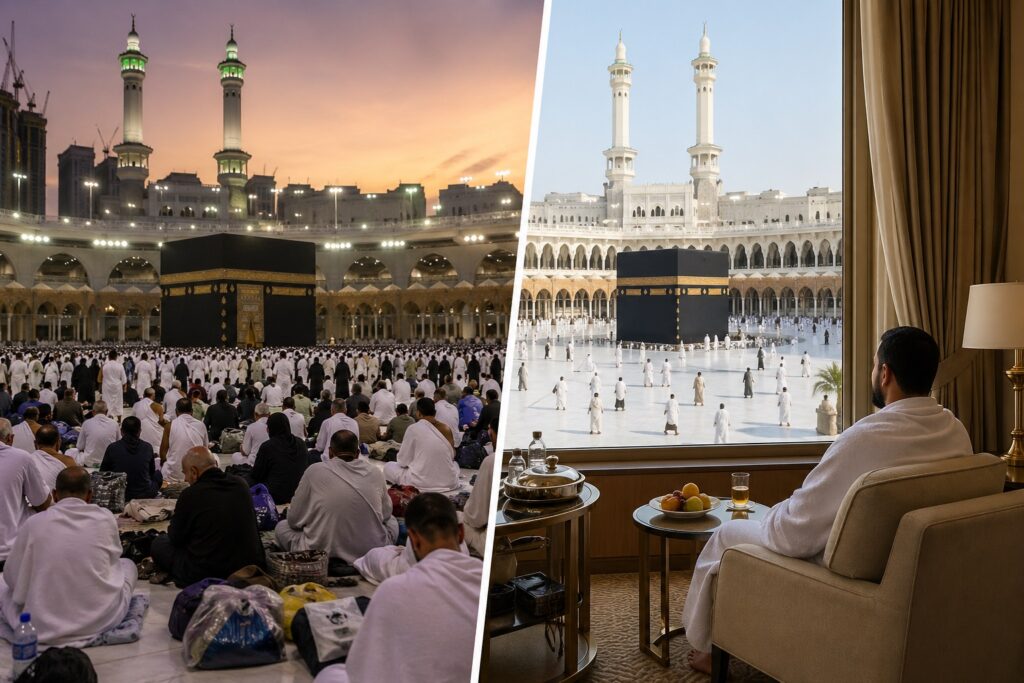
Let me be clear: this isn’t a choice about luxury. It’s a choice about how you’ll show up, both physically and spiritually, for one of the hardest trips of your life.
I’ve seen folks travel on a budget and come back changed. People have also pushed through illness and fatigue because they wanted to save money when their body wasn’t ready for it. It’s possible for both choices to be correct. The most important thing is to be honest with yourself about which one matches your life, not your ego or what appears nice on paper.
So, what’s really different?
The only difference is distance and comfort.
Most of the time, economy packages place you in 3–4-star hotels in Zone B or C. This means you’ll have to take busses to the Haram, wait in queues, and deal with crowds at all hours. There will be three or four other persons in your room. Meals are set and simple. The sensation is real and true, yet it requires something from you physically.
VIP packages bring you near to the Haram, often only a short walk away. You sleep in a five-star room, generally with only one other person or by yourself. Buffets are the right kind of meals. Transportation is either private or semi-private. And if something goes wrong (which always happens during Hajj), you may typically ask for help from a guide or a doctor.
Neither one will make your Hajj more accepted. But if you’re not 30 and your knees are fine, you might be able to survive it.
Let’s Talk About Money—Honestly
For pilgrims from Pakistan, preliminary predictions for 2026 are:
- Cost: 1.2M to 1.8M PKR per person
- VIP: PKR 2.5M to 4.5M+ for each person
That’s not a little change. VIP might cost two to three times as much. There are also hidden charges in both. For example, economic packages frequently don’t include Qurbani, and in VIP, you’ll probably spend more because the setting makes you want to.
Sharing is one thing that alters the numbers. The pricing is substantially different for a couple or family in a VIP double room than for a single traveler. Before you make a decision, run the figures.
Who Should Go for the Economy?
If you’re in good shape, care about your money, and know what you’re getting into, economy is the way to go. You’ll have to walk more, wait longer, and sleep in smaller spaces, but you’ll be able to fully meet your commitment and pay a lot less than VIP.
If selecting VIP would entail getting into debt, using up all your funds, or worrying about money the whole vacation, please choose economy. Hajj may be hard on your finances, which is a type of distraction in and of itself. Go light and be honest.
Who Should Be a VIP?
VIP isn’t about being important. I want to make that apparent. It’s about getting rid of things that might otherwise get in the way of your worship.
VIP or 5-star Hajj package is a good choice if you’re older, have a heart issue, diabetes, or joint difficulties, are traveling with small kids, or really have the money. It’s better for your soul to arrive to Fajr prayer relaxed and focused than tired and barely able to function. You really need to assess carefully which company is offering real quality 5-star Hajj services.
It’s not about comfort. It’s whether the comfort is helping you worship better or taking you away from the spirit of the journey.
The Spiritual Angle (and Why People Don’t Talk About It Enough)
Some people think that going through Hajj on a budget is more spiritually pure. And there is something to it: the hard work, the mutual sacrifice, and the loss of comfort. That’s true.
But Islam is also quite useful. It is your duty as a Muslim to take care of your health. You won’t get any more rewards for going to Hajj tired and unprepared; it merely puts you in danger.
The truth is that what you want to do is the most important thing. If you prefer to live simply and be careful with your money, that’s a good thing. It’s also honorable to pick VIP to safeguard your health and focus your adoration. Choosing VIP to impress people or economy and being miserable and angry the whole trip is not a good idea.
A Simple List of Things to Do Before You Book
Answer these questions honestly:
- Is it possible for me to afford VIP without going into debt or stress? If no, the solution is economics, period.
- Can I walk large distances in the heat of Makkah? If you’re really not sure, take it into account.
- Is my group old, sick, or traveling with kids? If so, go with a VIP package or at least a mid-tier one.
- Have I checked that the operator is registered with the government? Do this no matter what kind of box it is.
- Have I seen real evaluations, not just testimonials on the operator’s own website? Do this as well.
Three Real-Life Situations
The economy is the best choice for a young couple with little money saved. They’re in good shape, they’re adaptable, and the money they save is money they won’t have to pay back for the next ten years. The service providers cover all basic things in this package professionally like passport, visa, documents, preparation and accommodation.
VIP: Elderly parents going for their first Hajj. The peace of mind that comes from knowing they won’t be stuck on a bus at 2 a.m. or pass out from the heat is worth the expense many times over.
For a family with kids of different ages and incomes, look at mid-tier or “premium economy” packages. There is always a sweet spot between basic and complete luxury that provides the basics without going overboard.
In the end, the best package is the one that enables you be totally present—mentally, physically, and financially. The rest is all about getting things done.
